
Great Lakes Region Positions Itself as a Unified Economy on the Global Stage

The Great lakes Economic Development Council is a community that collaborates to grow a prosperous and sustainable future for the Great Lakes region of North America.
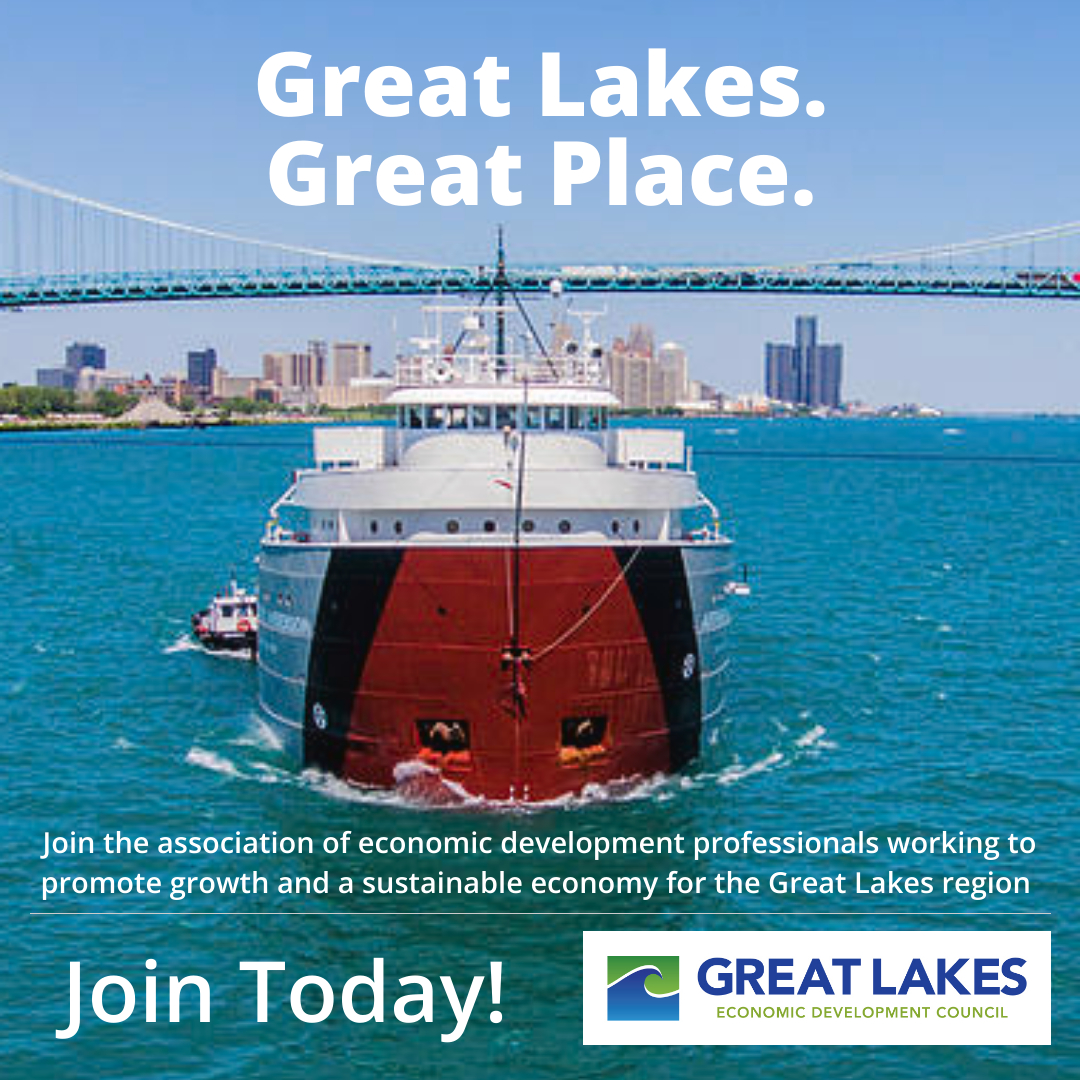
Join a community of economic developers driving progress and prosperity for the Great Lakes region of North America.
Cross-border collaboration across infrastructure, trade, freshwater innovation, and maritime logistics is shaping the Great Lakes economy’s next chapter
DETROIT, MI, UNITED STATES, January 4, 2026 /EINPresswire.com/ -- Economic development leaders across the Great Lakes region are increasingly aligning across borders and jurisdictions to position the area as a single, globally competitive economy. Spanning multiple U.S. states and Canadian provinces, the region functions as an integrated system for trade, manufacturing, logistics, and innovation—one where collaboration is central to long-term competitiveness.The Great Lakes Economic Development Council (GLEDC) says this regional approach reflects economic reality. Supply chains, labor markets, and transportation networks routinely cross the U.S.–Canada border, particularly between Great Lakes states and Ontario. As a result, economic developers are placing greater emphasis on coordination rather than competition among neighboring jurisdictions.
“The Great Lakes doesn’t compete as individual communities,” said TIm Hindes, GLEDC Execuve Director. “It competes as a region, and the strongest outcomes come when we collaborate across borders on shared priorities.”
Infrastructure that anchors a binational economy
One of the most visible examples of cross-border collaboration is the Gordie Howe International Bridge, nearing completion between Windsor, Ontario, and Detroit, Michigan. Jointly advanced by the United States and Canada, the bridge will provide a modern, high-capacity trade crossing in one of North America’s busiest commercial corridors.
Public officials on both sides of the border have described the project as transformative for trade and supply chain efficiency, citing reduced congestion, improved reliability, and long-term economic benefits. For economic developers, the bridge reinforces the importance of coordinated planning and shared investment across jurisdictions.
Trade corridors that support manufacturing and jobs
Beyond Detroit–Windsor, cross-border collaboration is embedded throughout the Great Lakes economy. Trade corridors anchored by crossings such as the Blue Water Bridge between Michigan and Ontario support advanced manufacturing, automotive supply chains, and logistics operations serving both countries.
Federal analyses have highlighted the Blue Water region as an example of binational trade driving regional growth, illustrating how economic activity on one side of the border is closely tied to outcomes on the other. Communities along these corridors increasingly coordinate strategies related to industrial readiness, transportation access, and workforce development.
GLEDC notes that this coordination helps communities communicate regional scale and connectivity—an important factor for companies evaluating market access and supply chain resilience.
Maritime supply chains and the Great Lakes–St. Lawrence system
Maritime commerce remains a defining feature of the Great Lakes economy. The Great Lakes–St. Lawrence Seaway system connects inland manufacturing and agricultural producers to global markets, supporting thousands of jobs and billions in economic activity across both countries.
Infrastructure planning and investment strategies for the Seaway are inherently binational, involving U.S. and Canadian agencies, port authorities, and industry groups. These efforts focus on maintaining navigation reliability, modernizing ports, and strengthening supply chain resilience.
Economic developers say this shared approach reinforces the region’s role as a globally connected manufacturing and logistics hub while supporting continued public investment in critical infrastructure.
Freshwater innovation as a shared opportunity
Freshwater is both a defining asset and a growing innovation driver for the Great Lakes region. Cross-border collaboration increasingly extends into water technology, infrastructure modernization, and resilience planning.
Binational initiatives led by organizations such as AquaAction, in partnership with municipal and regional organizations across the basin, emphasize innovation without borders. These efforts connect entrepreneurs, utilities, researchers, and local governments to pilot and scale solutions addressing shared water challenges.
Public statements from leaders involved in these initiatives consistently highlight the importance of treating freshwater as a shared responsibility and economic opportunity—particularly as climate pressures and infrastructure needs grow.
GLEDC views freshwater innovation as an area where economic development, environmental stewardship, and entrepreneurship intersect, creating opportunities that benefit communities throughout the region.
Governance and coordination across shared resources
Formal collaboration among Great Lakes institutions has also expanded. In 2024, the Great Lakes Commission, Great Lakes Fishery Commission, and the International Joint Commission Great Lakes Regional Office signed a memorandum of understanding to improve coordination on science, policy alignment, and joint activities.
While focused on governance and stewardship, such agreements provide economic developers with greater certainty around long-term resource management—an important consideration for industries dependent on water quality, availability, and ecosystem health.
The Great Lakes Fishery Commission has similarly emphasized that effective management requires binational cooperation because shared resources do not follow political boundaries, reinforcing a principle that increasingly shapes regional economic planning.
Municipal leadership and regional advocacy
Municipal leaders throughout the Great Lakes and St. Lawrence region have also elevated cross-border collaboration as a priority. Public statements tied to events such as Great Lakes Day have emphasized the economic importance of U.S.–Canada trade, particularly for border communities and manufacturing centers.
Mayors and local officials have pointed to shared interests in infrastructure funding, trade stability, and workforce mobility, reinforcing the idea that regional prosperity depends on alignment across jurisdictions.
GLEDC sees municipal engagement as a critical component of regional competitiveness, particularly when local perspectives inform state, provincial, and federal advocacy.
A practical agenda for economic developers
According to GLEDC, cross-border collaboration becomes meaningful when it translates into practical tools and shared learning. Over the coming year, the Council will continue to focus on areas where regional coordination offers the greatest value:
Trade and logistics readiness, including clearer communication of port, rail, and border access
Workforce and talent mobility, recognizing that labor markets often span borders
Freshwater innovation and resilience, linking stewardship to economic opportunity
Regional storytelling, presenting the Great Lakes as an integrated economic system
A recent industry report covering GLEDC’s inaugural annual conference in Detroit highlighted the Council’s binational focus and emphasis on regional scale as defining features of its mission.
“Cross-border collaboration isn’t aspirational here—it’s operational,” said Hindes. “Our role is to help economic developers connect faster, learn from each other, and compete more effectively as a region.”
About the Great Lakes Economic Development Council
The Great Lakes Economic Development Council (GLEDC) is a binational organization connecting economic development professionals across the Great Lakes region. GLEDC advances regional competitiveness through collaboration, shared learning, and cross-border relationship-building among leaders in U.S. states and Canadian provinces. The Council focuses on issues central to the Great Lakes economy, including trade, infrastructure, innovation, sustainability, and talent.
Lindsay Henry
Great Lakes Economic Development Council
+1 7047695200
email us here
Visit us on social media:
LinkedIn
Facebook
Legal Disclaimer:
EIN Presswire provides this news content "as is" without warranty of any kind. We do not accept any responsibility or liability for the accuracy, content, images, videos, licenses, completeness, legality, or reliability of the information contained in this article. If you have any complaints or copyright issues related to this article, kindly contact the author above.
