

American Communities Fight Existential Threat of Atomic Clock
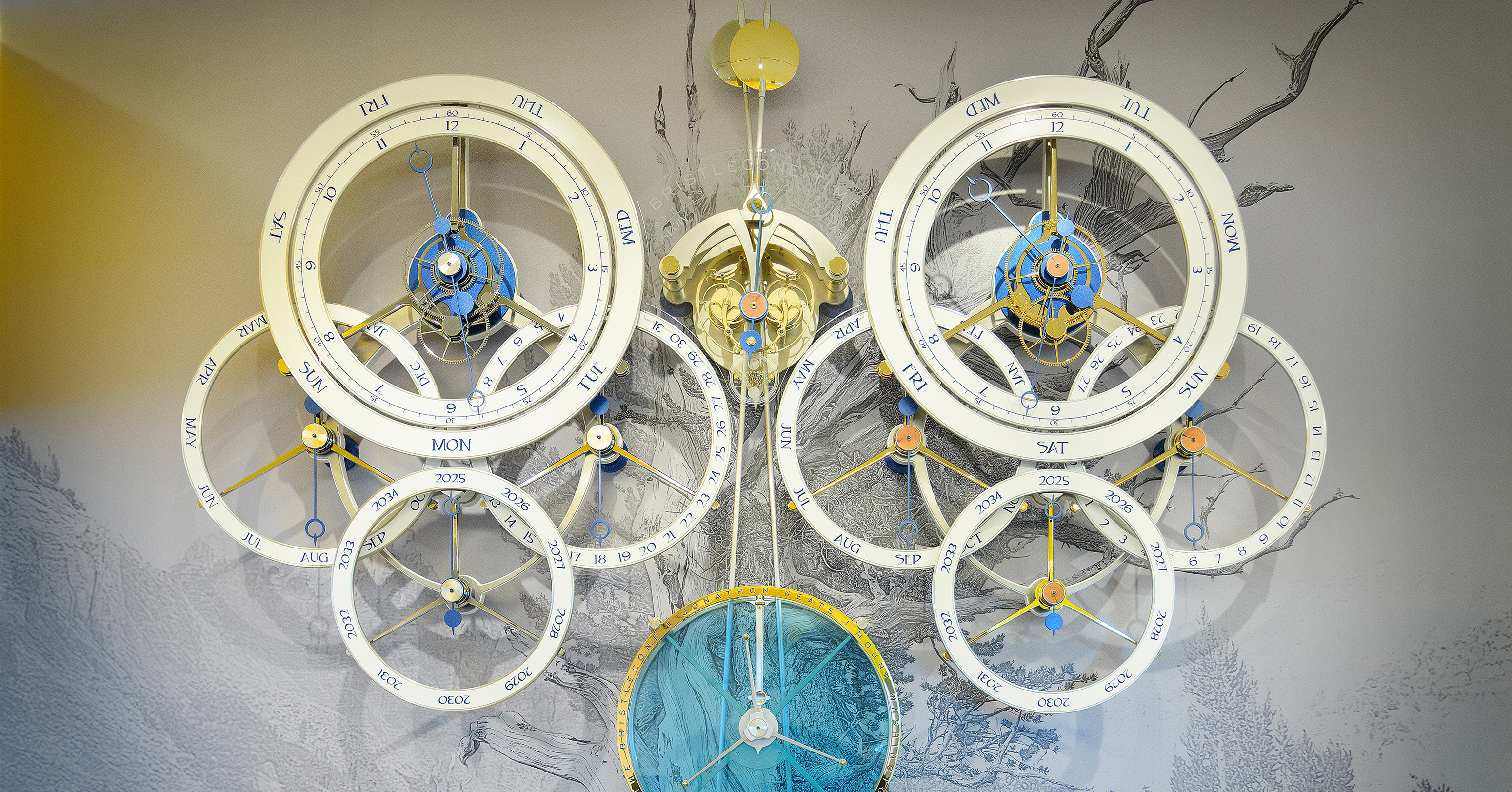
Installation view of an arboreal clock commissioned by the Nevada Museum of Art and situated at the Institute for Art + Environment. Conceptualized by Jonathon Keats, built in collaboration with horologists Phil Abernethy and Brittany Nicole Cox. Photo: Asa Gilmore
Alternative Time Standard To Be Calibrated By Growth Of Trees… San Francisco Firm Will Offer Novel Financial Instruments Temporally Indexed To Tree-Ring Data
“Time will no longer be imposed upon us by a cesium fountain clock at the National Institute of Standards and Technology,” says experimental philosopher Jonathon Keats, who is leading the initiative in association with the Institute for Art + Environment and the Long Now Foundation. “From Big Ben to Google Calendar, mechanical and electronic timekeeping devices have been responsible for more than a century of detachment from nature. We can overcome dehumanization and environmental devastation by pacing our lives to coincide with the temporal realities of other creatures.”
Prototyped on Mt. Washington in Nevada’s Great Basin, Mr. Keats’s alternative timekeeping system will initially derive from the metabolic rate of plants. As trees grow more rapidly, clocks will advance more quickly. The effect will be to synchronize human actions with the activity of other lifeforms such as sequoias, oaks, and bristlecone pines. The goal is nothing less than a revolution in global logistics and planning: to reintegrate Homo sapiens into the environment as a whole.
The prototype system in Nevada, which measures annual variation in bristlecone tree-ring growth to regulate a monumental municipal clock at the Nevada Museum of Art, serves as a conceptual foundation for several new developments in San Francisco. Of particular note are mechanisms to introduce arboreal time into musical performance by modifying the tempo of classic works such as Vivaldi’s Four Seasons. “We need to experience the temporalities of other beings in order to recognize them,” says Mr. Keats. “Musical entrainment is a first step toward empathic connection, and toward emotional appreciation of Earth as a living system inclusive of us.”
The San Francisco showroom will also be the location of the world’s first arboreal bond brokerage firm, imposing an environmental time standard upon the global economic system. Issued by seedlings and saplings, bearer bonds will pay interest in produce on a schedule calibrated by annual growth rate. Funds raised by the bonds will pay for irrigation and other landscaping needs, and will defray the cost of legal representation in case of environmental threats. “When the trees’ lives reach their natural conclusion, investors’ principal will be paid back in lumber,” Mr. Keats asserts. The seedling issuing the first bond, an oak of the species Quercus agrifolia, will attend the February 19th event prior to planting in the Santa Cruz Mountains on land administered by the Djerassi Resident Artists Program.
Mr. Keats notes that arboreal time is just one dimension of a much larger system in development. In fact, he has already prototyped an alternative mode of time reckoning in Alaska. “The flow of time is calibrated by the flow of glacial rivers, such as the Matanuska and Susitna,” he explains. An equivalent system will soon be introduced in Massachusetts, in collaboration with the MIT Museum.
In all of these initiatives — which will ultimately be aggregated into a global environmental timekeeping network — people are sensitized to their ecosystem and to climate change through the act of reckoning time. “Time becomes contingent, making us attentive to ground conditions,” says Mr. Keats.
Simultaneously environmental clocks and calendars create feedback loops, reestablishing planetary homeostasis.
“We can no longer afford to be detached,” Mr. Keats asserts. “We can no longer afford the luxury of an atomic clock and the industrialized economy driven by it. Or viewed from another perspective, we have the opportunity to experience the ultimate luxury — the satisfaction of living fully in the moment.”
The public is invited to visit the arboreal time showroom at Modernism from 6:00-8:00 PM, Thursday, February 19, 2026, or by appointment. The gallery is located at 724 Ellis Street in San Francisco. For more information, see https://www.modernisminc.com.
Jonathon Keats is an experimental philosopher, artist, and writer whose transdisciplinary projects explore all aspects of society, adapting methods from the sciences and the humanities. He has exhibited in museums worldwide and is the author of six books on subjects ranging from science and technology to art and design. https://naturalhistory.si.edu/staff/jonathon-keats
Jonathon Keats
MODERNISM INC.
+1 415-541-0461
jonathonkeats@gmail.com
Visit us on social media:
Instagram
Facebook
Legal Disclaimer:
EIN Presswire provides this news content "as is" without warranty of any kind. We do not accept any responsibility or liability for the accuracy, content, images, videos, licenses, completeness, legality, or reliability of the information contained in this article. If you have any complaints or copyright issues related to this article, kindly contact the author above.
