

From Ancient Methods to Intelligence: 3000 Years of Fire Assay Evolution and Automation Revolution
With the arrival of the Industrial Revolution, the fire assay process ushered in another major transformation. The improvement of high-temperature furnace equipment, the innovation of weighing equipment, and the standardized use of reagents shifted fire assay from an empirical skill gradually toward a scientific analysis method. Inherited to this day, fire assay has become the core process of precious metal detection in modern laboratories, and its technical principles and core procedures remain basically unchanged.
1. Key Procedures of the Fire Assay Process
The fire assay process consists of three core procedures, each with a clear purpose and specific operational steps and products.
First is fusion and collection, whose purpose is to concentrate precious metals from the sample into a lead button. During this procedure, samples are mixed with flux, lead oxide, and other substances, then melted at high temperatures. Lead is reduced in this process and forms an alloy with precious metals, which sinks to the bottom to become a "lead button".
Next is cupellation, which aims to separate and purify precious metals from the lead button. The lead button is placed in a porous bone-ash cupel and heated. At this time, lead is oxidized into lead oxide and absorbed by the cupel, leaving behind a pure precious metal bead.
Finally, there is parting and weighing, designed to separately determine the contents of gold and silver. Hot nitric acid is used to dissolve the silver in the precious metal bead, and the remaining substance is pure gold. By weighing the pure gold and the dissolved silver separately, the gold and silver content in the original sample can be calculated.
2. Challenges of Traditional Manual Fire Assay
Developing to the present, although the fire assay process retains core procedures such as dosing, fusion, cupellation, and parting, the operation mode still continues the manual-dominated tradition – technicians complete every process using simple tools in high-temperature environments, where experience and skill become the key guarantee of quality. This also hides many risks:
Operation processes and results depend heavily on experience, making consistency difficult to maintain.
Precious metal recovery rates fluctuate greatly, and the risk of silver loss remains high.
Labor intensity is high, and safety risks are prominent.
Efficiency bottleneck is obvious, making it difficult to scale.
Data traceability and consistency are difficult challenges.
It is not difficult to see that traditional solutions over-reliant on manual labor have seriously hindered the development process of fire assay technology. Therefore, whether this process can be transformed into a programmable, monitorable, and reproducible automated solution has become the key to technical innovation.
3. The Automated Solution by QINGDAO DECENT GROUP
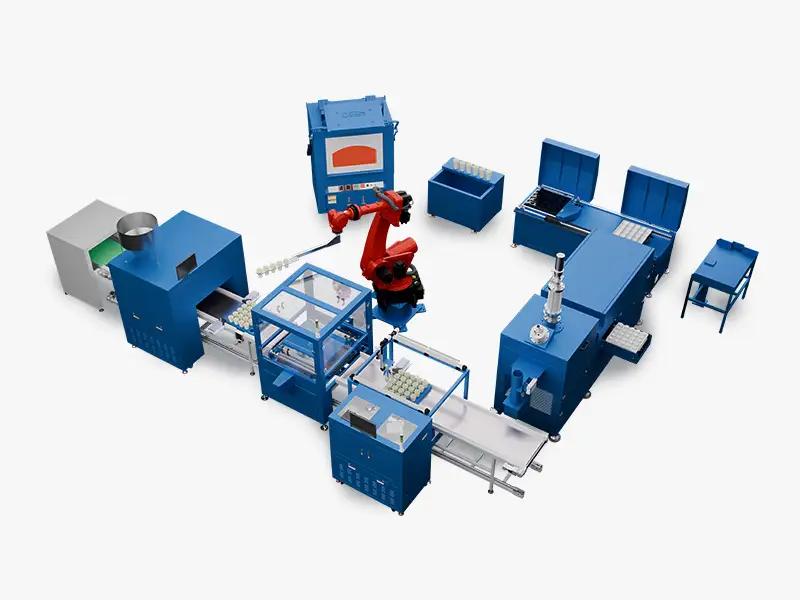
Targeting this issue, QINGDAO DECENT GROUP, after deep R&D and rigorous testing, officially launched the Fire Assay Automation System Solution. Through intelligent design, it achieves full-process automated operation from sample dosing to final cupellation, freeing it from the reliance on manual operation, significantly improving the precision of detection procedures and the accuracy of experimental results, and pushing the fire assay industry to accelerate into a high-automation era.
3.1 Six Core Modules of the System
Automatic Flux Dosing Machine: Adopts an anti-cross-contamination design and adds materials precisely according to the formula.
Crucible Mixer: Relies on a reduction motor-driven inversion to achieve efficient and uniform sample mixing.
Cover Agent Adding Machine: Precisely controls the spreading thickness to 8-10 mm.
Intelligent Fusion Furnace: Provides stable temperature control at 1200°C.
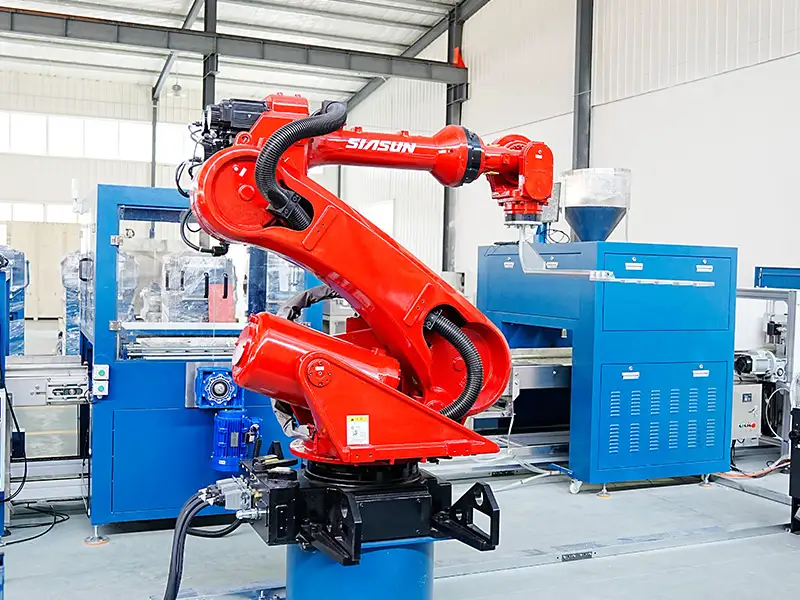
Automatic Steel Mold Turner: Collaborates with a robotic arm to achieve cooling and lead button separation in one step.
Visual Cupellation Furnace: Equipped with core patented technology, which can automatically judge the cupellation endpoint and take out samples individually.
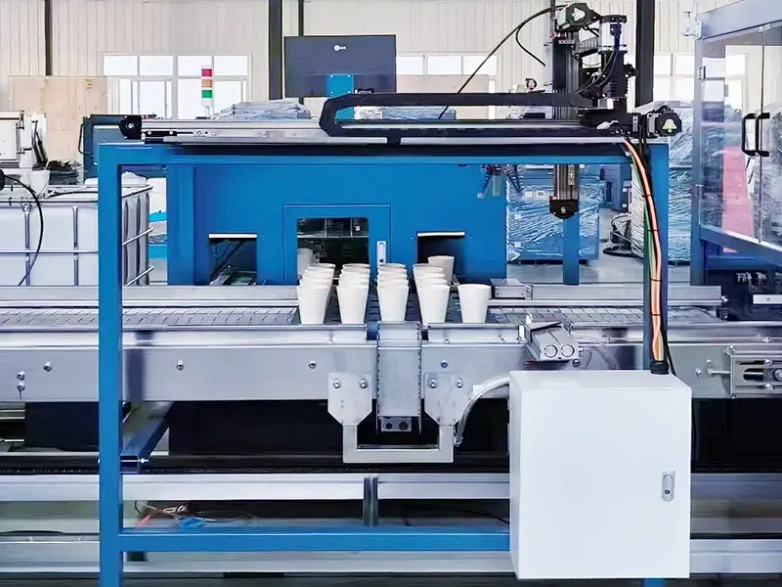
These six major modules are connected through an intelligent robotic arm and track transmission system for full-process intelligent linkage, integrating the complex procedures of traditional fire assay into an efficient and precise integrated workflow, forming a highly automated organic whole, which significantly improves fire assay detection efficiency.
4. Comparative Advantages: Automation vs. Manual
In terms of operation mode, traditional manual operation requires technicians to be on-site, and the entire process is experience-led, which is highly dependent on the individual capabilities of the operators. In contrast, the QINGDAO DECENT GROUP automation system achieves full-process automatic operation and supports remote monitoring, greatly reducing the demand for on-site personnel and the impact of human factors.
In terms of data precision, traditional manual operation is prone to large human errors, and there are obvious batch fluctuations in experimental results, making it difficult to guarantee the stability of data. The automation system adopts programmed control, and the repeatability error is close to zero, ensuring the high precision and stability of experimental data.
In terms of safety guarantee, technicians in traditional manual operation are directly exposed to high-temperature environments, and safety risks are prominent, which may easily lead to safety accidents. The automation system realizes human-machine separation and is equipped with a comprehensive safety design, effectively avoiding the direct contact between personnel and high-risk environments and greatly improving the safety of the operation process.
In terms of data traceability, traditional manual operation relies on manual recording of experimental data, which is not only time-consuming and labor-intensive but also prone to errors and omissions, making it difficult to fully trace the data. The automation system conducts full-process digital recording of experimental data, which can be searched in real-time, ensuring the complete traceability of data and facilitating subsequent query and analysis.
In terms of efficiency and capacity, traditional manual operation usually requires one person to manage one furnace, and the capacity is limited, which cannot meet the needs of large-scale detection. The automation system can operate continuously for 24 hours, significantly increasing the detection capacity and greatly improving the overall efficiency.
5. Conclusion and Future Outlook
QINGDAO DECENT GROUP's Fire Assay Automation System Solution empowers detection through automation technology. It not only achieves long-term progress in efficiency, safety, and accuracy at the technical level but also provides new development ideas for industry efficiency improvement and the transformation of new quality productive forces, setting a new industry paradigm.
From the separation of gold and silver thousands of years ago, to precision analysis in modern laboratories, and up to the innovation of fire assay automation, the core demand has always revolved around the three keywords: "More precise, more efficient, more safe".
The advancement of the QINGDAO DECENT GROUP Fire Assay Automation System Solution is reflected not only in the overall solution but also in every single link of the system. Regarding this point, in the next issue, we will provide an in-depth interpretation of the six core modules of QINGDAO DECENT GROUP.
About QINGDAO DECENT GROUP
QINGDAO DECENT GROUP is rooted in China with a global vision, committed to becoming a comprehensively leading service provider of mineral laboratory equipment and one-stop solutions. Relying on profound industry accumulation and continuous innovation capabilities, we focus on the research and development of intelligent, efficient, and safe laboratory equipment and instruments, providing full-chain solutions for China's mineral testing industry and scientific research institutions. Our core business layout covers fire assay experimental equipment and consumables, mineral product sampling equipment, mobile container laboratories, laboratory safety products, and detection analysis instruments.
For a deeper understanding of DECENT's comprehensive laboratory solutions, please visit: https://www.decent-group.com.
Qingdao Decent Electromechanical Tech Co., Ltd.
Qingdao Decent Electromechanical Tech Co., Ltd.
+86 18866627651
hydewang@marslabtech.cn
Visit us on social media:
LinkedIn
Instagram
Facebook
YouTube
Other
Legal Disclaimer:
EIN Presswire provides this news content "as is" without warranty of any kind. We do not accept any responsibility or liability for the accuracy, content, images, videos, licenses, completeness, legality, or reliability of the information contained in this article. If you have any complaints or copyright issues related to this article, kindly contact the author above.
