

Bonita Estero Rail Trail Lawsuit Filed; Meetings Announced for Adjacent Landowners

Bonita Estero Rail Trail Town Hall Meetings
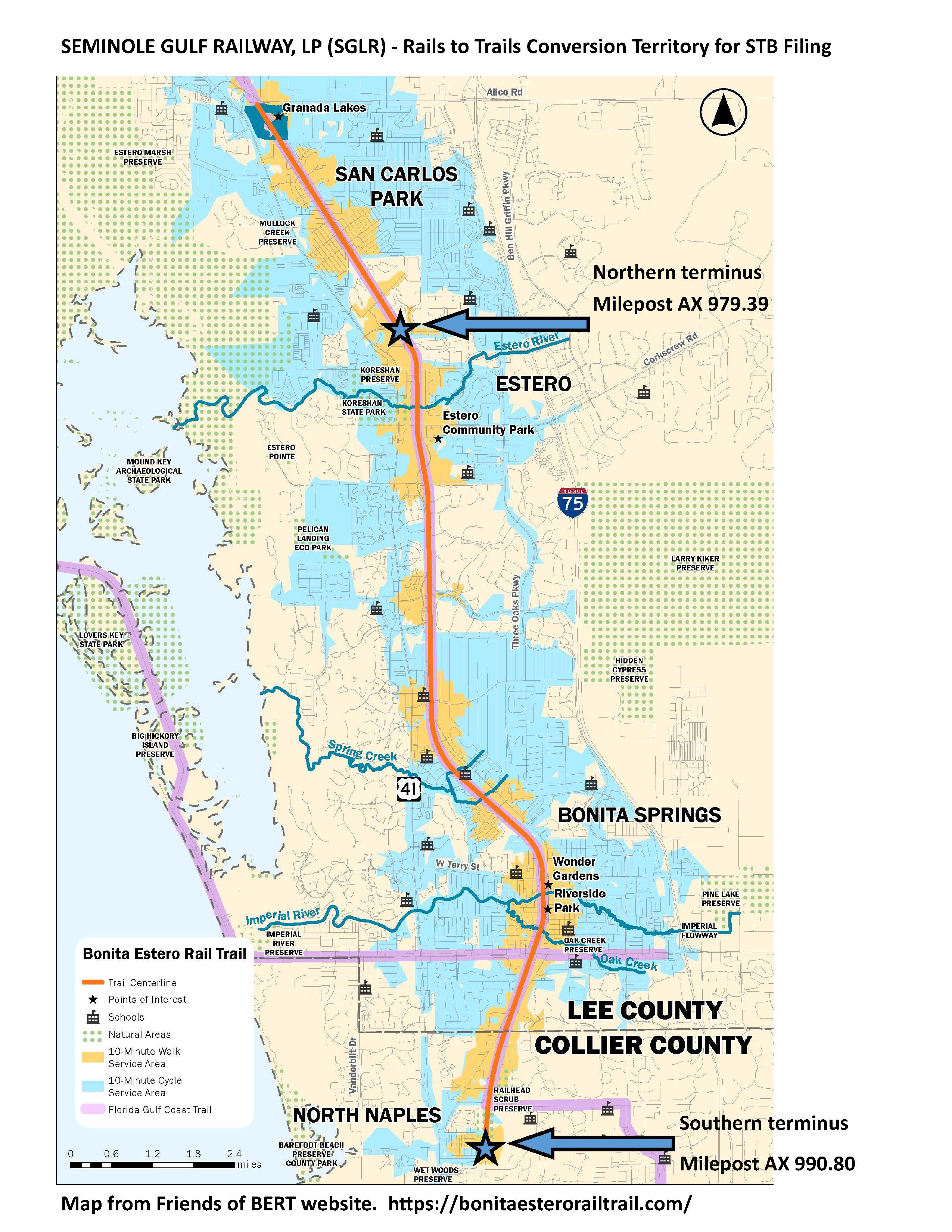
Bonita Estero Rail Trail Conversion Map
These cases are about ensuring that when the federal government uses the Trails Act in a way that affects property rights, landowners receive the just compensation guaranteed by the Fifth Amendment”
BONITA SPRINGS, FL, UNITED STATES, August 21, 2026 /EINPresswire.com/ -- Stewart, Wald & Smith, LLC ("SWS"), a national law firm focused exclusively on representing landowners in Rails-to-Trails litigation, has filed a lawsuit in the United States Court of Federal Claims, Sage Naples, LLC, et al. v. United States, Case No. 26-1070L, on behalf of seventeen property owners whose land adjoins the proposed Bonita Estero Rail Trail corridor in Lee County, Florida.— Steven M. Wald
The lawsuit follows the Surface Transportation Board's issuance of a Notice of Interim Trail Use ("NITU") on July 24, 2026, authorizing railbanking negotiations for approximately 11.4 miles of the former Seminole Gulf Railway corridor extending from Estero through Bonita Springs.
The complaint alleges that the federal government's authorization of railbanking prevented the railroad easement from terminating under Florida property law. Because the federal action preserved the corridor for future railroad use while authorizing interim recreational trail use, the lawsuit contends that the United States effected a taking of private property requiring the payment of just compensation under the Fifth Amendment.
The complaint seeks compensation from the United States government under the Fifth Amendment to the U.S. Constitution. It does not seek to stop construction of the Bonita Estero Rail Trail and is not a lawsuit against Lee County, Collier County, the Trust for Public Land, Friends of Bonita Estero Rail Trail (BERT), or any other organization involved in developing the trail.
Why a Federal Lawsuit?
Many landowners ask why a lawsuit is necessary if they support the trail or if the trail is going to be built anyway.
The answer lies in the way many railroad corridors were originally acquired.
In many locations across the country, railroads did not purchase the land outright. Instead, they acquired only an easement allowing trains to operate across private property. Under traditional property law, once railroad operations permanently end, those easements may terminate, and the property interest may revert to the adjoining landowners.
However, Congress created a federal process known as railbanking through the National Trails System Act. Rather than allowing a railroad easement to end, the federal government may preserve the corridor for possible future railroad use while authorizing interim public recreational trail use.
When federal railbanking prevents an easement from terminating, courts have repeatedly held that some adjoining landowners may have suffered a compensable taking of private property under the Fifth Amendment. In those situations, the Constitution requires the federal government to pay just compensation.
Whether any particular property qualifies depends upon the railroad's property interest and other legal factors unique to each parcel.
Filing Deadline Is Strict:
Rails-to-Trails claims are governed by a statute of limitations. Property owners must file within 6 years following the issuance of the Notice of Interim Trail Use. Waiting too long may permanently bar an otherwise valid claim.
The recently filed lawsuit represents the first group of landowners seeking compensation arising from the Bonita Estero Rail Trail project. Eligible property owners still have time to pursue claims.
Upcoming Informational Meetings:
To help adjacent property owners better understand the legal process and determine whether their property may be affected, Stewart, Wald & Smith will host two complimentary informational meetings.
Thursday, September 3, 2026
Time: 5:00 p.m.
Location: Courtyard by Marriott Fort Myers at I-75 & Gulf Coast Town Center, 10050 Gulf Center Dr. Fort Myers, FL 33913
Friday, September 4, 2026
Time: 9:00 a.m. & 12:00 p.m.
Location: The Warehouse Café, Upper Room, 4461 Bonita Beach Rd. Bonita Springs, FL 34134
During the meetings, attorneys will explain:
• How the federal railbanking process works.
• Why some landowners may own property interests beneath former railroad corridors.
• How compensation is determined.
• The federal filing deadlines.
• The steps involved in pursuing a Rails-to-Trails claim.
Attendees will also have an opportunity to ask questions regarding their individual properties.
A Constitutional Property Rights Case:
"Our firm is neutral regarding whether the trail should be built," said attorney Steven M. Wald. "These cases are not about stopping recreational trails. They are about ensuring that when the federal government uses the Trails Act in a way that affects private property rights, landowners receive the just compensation guaranteed by the Fifth Amendment."
SWS has represented thousands of landowners in Rails-to-Trails litigation nationwide and has recovered more than $415 million for property owners in successful Rails-to-Trails cases. The firm focuses exclusively on representing landowners in these constitutional property rights claims before the United States Court of Federal Claims.
Adjacent property owners who believe their land borders the Bonita Estero Rail Trail corridor are encouraged to attend one of the upcoming meetings or contact Stewart, Wald & Smith for a complimentary evaluation of their property rights.
For more information, visit www.swslegal.com or call (314) 720-0220.
Jackie Tebbe
Stewart Wald and Smith, LLC
+1 3147200227
email us here
Visit us on social media:
LinkedIn
Instagram
Facebook
YouTube
X
What is Rails-to-Trails Litigation?
Legal Disclaimer:
EIN Presswire provides this news content "as is" without warranty of any kind. We do not accept any responsibility or liability for the accuracy, content, images, videos, licenses, completeness, legality, or reliability of the information contained in this article. If you have any complaints or copyright issues related to this article, kindly contact the author above.
