

How policymakers’ speeches and interviews move markets
24 September 2026
By Klodiana Istrefi, Florens Odendahl, and Giulia Sestieri
Speeches and interviews given by policymakers between ECB Governing Council meetings can move financial markets just as much as the monetary policy decisions themselves. This blog shows how they can also help measure the effects of monetary policy on euro area inflation and unemployment.
The formal policy announcement that follows each Governing Council meeting – held approximately every six weeks – is the ECB’s primary channel for communicating its monetary policy stance.
However, communication does not stop between meetings. Central banks can also shape economic outcomes through their communication with experts and the wider public. Speeches and interviews given by policymakers offer insights into ongoing policy deliberations as well as the future policy direction. To understand their effect on markets, this ECB Blog post examines euro area market reactions to both formal policy announcements following Governing Council meetings and inter-meeting communication events in the form of speeches and interviews.[1]
Our findings show that the market reaction to inter-meeting communication events is often as large as the reaction to formal announcements of Governing Council decisions. We also find that inter-meeting communication events can help us better estimate the economic impact of monetary policy in the euro area.
A new database of communication between policy meetings
To study the market effects of policy and inter-meeting communication, we built the Euro Area Communication Event Study Database (EA-CED).[2] It includes 304 formal policy announcements following Governing Council monetary policy meetings and around 5,000 public communication events that took place between Governing Council meetings from January 1999 to early 2024. These inter-meeting communication events include speeches and interviews by ECB Presidents and Executive Board members. They also cover communication by the President of the Deutsche Bundesbank and the Governors of the Banque de France, the Banco de España and the Banca d’Italia, representing the national central banks (NCBs) of the four largest euro area countries (Germany, France, Spain and Italy).
We measured how financial market variables, including certain euro area interest rates, the stock market and the exchange rate, moved within a narrow time window around each event – i.e. the “surprise” reaction to the communication.[3] We then compared that surprise reaction to market conditions just before the event. This comparison against typical market fluctuations – called background market volatility – helps us better identify instances when policy and inter-meeting communication moved markets significantly.
We found that around 45% of formal policy announcements produced a significant market reaction. By contrast, the results from inter-meeting communication events were more diverse and a smaller share of them generated a significant market reaction. This is not surprising: formal policy announcements following Governing Council meetings are inherently focused on monetary policy decisions, whereas inter-meeting communication events cover a much broader range of topics. These may include financial stability, structural reforms, international developments or climate change, which do not always directly affect market expectations.
Yet there are far more speeches and interviews than formal monetary policy announcements. Their cumulative impact adds up, and the informal policy signals they provide can lead to a sizeable market reaction. In total, more than 300 inter-meeting communication events generated a significant reaction in the Euro Stoxx 50 index, compared with 117 formal policy announcements. Taken together, these events moved the index by 273 percentage points in cumulative terms. Meanwhile formal policy announcements moved the index by just 98 percentage points.
Speeches can move markets significantly
Our results clearly indicate that speeches and interviews which take place between Governing Council meetings can lead to significant movements in markets. Reactions to informal inter-meeting communication events can be as large as those to formal policy announcements, particularly for medium and long-term market rates.
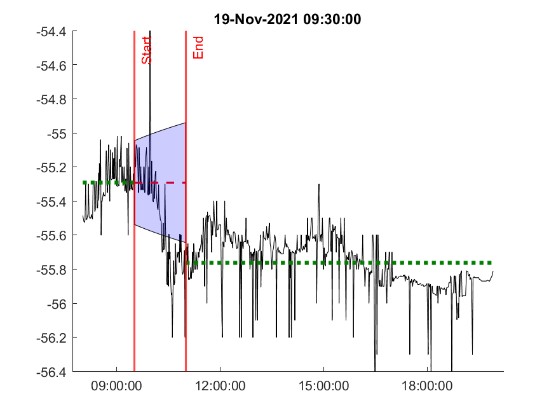
This is evident when we look at the effect on the one-year euro overnight risk-free rate (OIS 1Y) of three speeches given by different ECB Presidents (Chart 1). First, during Jean-Claude Trichet’s speech at the Frankfurt European Banking Congress in November 2005, the OIS 1Y jumped sharply.[4] Markets immediately began to expect the upcoming rate hike and the event made headlines. The New York Times wrote that the ECB had made it clear that it was going to raise rates and quoted Mr Trichet saying “We will remove some of the accommodation which is in the present monetary policy stance”.[5] In this event, the President had signalled the first ECB rate hike in five years, which was delivered in December 2005 after more than two years of unchanged policy rates.[6]
Chart 1
Three speeches from ECB Presidents that moved markets
a) Jean-Claude Trichet |
b) Mario Draghi |
c) Christine Lagarde |
 |
 |
 |
Source: Istrefi, K., Odendahl, F. and Sestieri, G. (2026).
Notes: The chart shows the intraday movements of the one-year overnight indexed swap rate (OIS 1Y), during former ECB President Jean-Claude Trichet’s speech on 18 November 2005, former ECB President Mario Draghi’s speech on 18 June 2019 and ECB President Christine Lagarde’s speech on 19 November 2021. The black line shows the minute-by-minute quotes of the OIS 1Y in basis points. The vertical red lines show the start and end time of each speech. The dotted green lines show the median OIS 1Y at 15-minute intervals, before the start and after the end of the speech. The shaded blue area shows where the OIS 1Y was expected to move based on the background market volatility before the speech.
Second, during Mario Draghi’s speech at the ECB Forum in Sintra on 18 June 2019, the OIS 1Y fell sharply. Draghi stated that “In the absence of improvement, such that the sustained return of inflation to our aim is threatened, additional stimulus will be required”. Commenting on the speech, Bloomberg wrote “Mario Draghi nudged the European Central Bank closer to pumping more monetary stimulus into the economy, highlighting that lingering risks are strengthening the case for action”.[7] And indeed, at the Governing Council meeting in September 2019, the ECB decided to lower the deposit facility rate further to ‑0.50% and announced the restart of net purchases through the asset purchase programme.
Third, during Christine Lagarde’s speech at the Frankfurt European Banking Congress on 19 November 2021, the OIS 1Y fell as markets took note of the signal on policy rates. In the speech, the President reiterated that “the conditions to raise rates are very unlikely to be satisfied next year” and warned that the ECB “must not rush into a premature tightening” of monetary policy. Picking up on her comments, CNBC’s headline read “ECB’s Lagarde says a rate hike unlikely for 2022; euro slides”.[8]
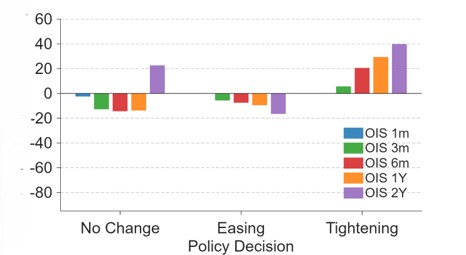
As these three examples show, speeches can move markets because they tend to anticipate monetary policy decisions. In fact, in the weeks before a Governing Council meeting, speeches shift the OIS rates in the same direction as the policy decision that follows (Chart 2). Before rate hikes, speeches and interviews push rates upwards. Before rate cuts, they push rates downwards, albeit more modestly. This asymmetry suggests that Governing Council members increase the strength of their communication more ahead of monetary policy tightening – signalling vigilance on inflation – than ahead of monetary policy easing. The pattern is less clear before meetings with no change in policy.
Chart 2
Cumulative OIS surprises ahead of Governing Council meetings
Source: Istrefi, K., Odendahl, F. and Sestieri, G. (2026).
Notes: The chart shows the cumulative (significant) market reaction as the basis point change in the overnight index swap rate at different maturities for inter-meeting communication events preceding Governing Council meetings. We have grouped the events by the policy decision that followed: no change, easing (a reduction in the deposit facility rate) or tightening (an increase in the deposit facility rate).
Overall, in terms of cumulative effects, formal policy announcements following Governing Council meetings have a larger impact on short-term OIS rates.[9] But for the two-year euro overnight risk-free rate (OIS 2Y), the cumulative effects of formal policy announcements and inter-meeting communication events are similar (a change of 718 basis points for formal policy announcements compared with 681 basis points for inter-meeting communication events). At longer maturities, inter-meeting communication events become more influential, with cumulative effects up to twice as large as those of formal policy announcements.
If we look instead at the average impact, formal policy announcements move markets more than inter-meeting communication events. However, that gap narrows at longer maturities.[10] In the period from 1999 to 2024, the average impact on the OIS 2Y of formal policy announcements was 5.13 basis points. For inter-meeting communications events during this period, the average impact was 2.56 basis points for speeches by ECB Presidents (excluding European Parliament hearings), 2.14 basis points for speeches by Executive Board members, 2.42 basis points for speeches by the President and Governors of the four NCBs and 2.62 basis points for interviews involving all of these policymakers. Therefore, of the inter-meeting speakers, the ECB President has the largest impact on average, followed closely by the President and Governors of the four NCBs and then the ECB Executive Board members. This highlights the importance of looking beyond the ECB President and Executive Board members when analysing monetary policy communication in a heterogeneous monetary union, where countries differ significantly in their economic structures, public debt levels and household and firm financial situations.
Better estimates of the impact of monetary policy on the economy
Beyond the immediate reaction of financial markets, our database can also be used to estimate how monetary policy affects the broader economy. To do this, we used a Bayesian vector autoregression model. This is a standard statistical tool that traces how a change in one variable – such as a rise in interest rates – ripples through the economy over time. We used the model to measure how sudden and unexpected changes in monetary policy (so-called monetary policy shocks) affect unemployment and inflation, with the EA-CED helping to identify genuine moments of shock or surprise. Focusing on shocks allows us to isolate unexpected changes in monetary policy, rather than policy changes that simply reflect the central bank’s response to economic conditions. Our results show that intra-meeting communication events are important measures of monetary policy transmission.
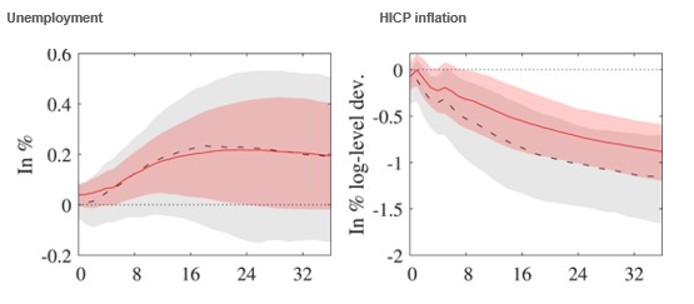
Chart 3 compares the effects of a monetary policy tightening shock on unemployment and euro area inflation as measured by the Harmonised Index of Consumer Prices (HICP), under two measures of the shock. The measures are informed, respectively, by surprises from inter-meeting communication events (red line) and formal policy announcements (black line) included in the EA-CED. In both cases, HICP inflation falls and unemployment rises in response to monetary policy tightening, which is consistent with economic theory. However, the estimates based on surprises from inter-meeting communication events are more precise, as the confidence bands in red are tighter than those in grey. When we base the information in the model on surprises from the formal policy announcements alone, the unemployment response is statistically insignificant. We can therefore say that the effects are clearer and more significant when using information from inter-meeting communication events.
Chart 3
Effect of monetary policy tightening on unemployment and HICP inflation
Source: Istrefi, K., Odendahl, F. and Sestieri, G. (2026).
Notes: The charts show the impulse response functions of the euro area unemployment rate and the log level of the euro area harmonised index of consumer prices (HICP) index to a 25 basis point monetary policy tightening shock. The dashed black line and shaded grey area show results using information based on surprises from formal policy announcements and the red line and red shaded area show results based on those from inter-meeting communication events. The x-axis is in months.
Conclusion
Speeches and interviews by ECB Governing Council members can move financial markets significantly – and sometimes by just as much as formal policy announcements. Between the ECB’s Governing Council meetings, these communication events provide important signals for the future direction of monetary policy. They can also help us understand how monetary policy shapes inflation and unemployment in the euro area. In this way, communication events that take place between Governing Council meetings are a measurable and informative part of the monetary policy transmission process.
The views expressed in each blog entry are those of the author(s) and do not necessarily represent the views of the European Central Bank and the Eurosystem.
Check out The ECB Blog and subscribe to receive future posts via email.
For topics relating to banking supervision, why not have a look at The Supervision Blog?
Legal Disclaimer:
EIN Presswire provides this news content "as is" without warranty of any kind. We do not accept any responsibility or liability for the accuracy, content, images, videos, licenses, completeness, legality, or reliability of the information contained in this article. If you have any complaints or copyright issues related to this article, kindly contact the author above.
